Valves for Municipal Water Distribution, Storage, and Wastewater Treatment

Valves for Municipal Water

Most of the operations in the water and wastewater industries, from treatment to storage, to distribution, rely heavily on pipeline infrastructure. Pipeline infrastructure and dependable control systems are critical to the sector's success. Any systemic flaws or weaknesses could lead to significant losses, dangerous spills, and environmental disasters. 

The safe operation of municipal water systems relies heavily on industrial valves. Among other things, they are in charge of flow management and ensuring the integrity of supply lines. The following is a listing to understand better the performance and applications of the different industrial valves applied in municipal water systems. 

In systems that require precise flow control, globe valves often regulate and control liquid flow. They're also suitable for cutoff, but they're usually more expensive than gate valves. 

The most commonly encountered type of valve is the gate valve. Gate valves are employed to start and stop the flow of liquid. These valves are either completely open or completely closed in reality. These are fantastic shut-off valves. Gate valves come in various forms to suit a wide range of applications. 

Butterfly Valves regulate and stop the flow of water. These valves are small and light, taking up less room than valves that perform equivalent duties. 

A quarter-turn valve used in shutdown applications is a ball valve. The valve uses an embedded ball that spins within the valve body to control fluid flow. Because ball valves are lighter and more compact than gate valves, they are preferred for on-off applications.

In a pipeline system, check valves are responsible for preventing backflow. A check valve opens when fluid travels through a line; however, when the flow reverses, the valve closes. 

High-pressure events or vacuums can harm a pipeline system; thus, the installation of relief valves protect it. The pipeline pressure is not fully released because the valves only release the pressure to a predefined point. Relief valves come in various shapes and sizes to suit a variety of purposes. 

Pinch valves are linear motion valves utilized in piping systems that handle solids, slurries, and thick fluids for throttling and shutdown. A pinch valve uses a pinch tube to control the flow. 

Automatic Controls of Virginia, based in Ashland, Virginia, is a significant distributor of municipal water system valves. 

Automatic Controls assists customers with application, design, product start-up help, product service training, and support and works with some of the most well-known and forward-thinking valve manufacturers on the market today.

Automatic Controls of Virginia
https://acva.com
(804) 752-1000 

Hydraulic Press Safety and the Role of Pressure Switches

Hydraulic Press Safety and  the Role of Pressure Switches

Hydraulic systems have various functions and applications, from industrial manufacturing to robotics and steel processing. They are analogous to pneumatics, which easily compressible gas to perform tasks. Hydraulic systems, on the other hand, use incompressible liquids as their fluid rather than compressible gases. Repetition–hydraulic systems are industry preferred low-cost, efficient ways to generate movement. 

To use these systems effectively, workers must understand the risks and potential hazards associated with hydraulics. Your employees could be in danger if they are unaware of the extreme fluid pressure, maintenance, and heavy workload. Fortunately, various safety precautions reduce the risk of injury or death significantly. 

Our hydraulics safety precautions guide will cover common hazards and precautions to keep you and your employees safe.

How Does A Hydraulic Press Work? 

Hydraulic press systems use a pump that pushes fluid throughout the machine to create energy in its simplest form. The fluid then enters a set of valves and flows to the cylinder, where hydraulic power changes back to mechanical energy. When necessary, these valves also help control the liquid’s movement and relieve pressure.

There are several types of hydraulic press systems on the market. Depending on your application or industrial setting, you will most likely use one of the following: 

  • An Arbor press uses a narrow range to support the disposal, seating stamping, manufacturing, and repairing of equipment.
  • An H Frame press (or four-column) is the standard in many businesses for its versatility. They are used to straighten, bend, shape, stamp, or cut metal objects.
  • C Frame press systems are relatively smaller than H frames but maintain similar utility and flexibility in a light yet compact build.
  • Custom presses provide solutions for a company’s personal needs and specifications.
  • Press brakes clamp and bend sheet metal and plate material.
Although these machines make work easy and productive, they are still highly dangerous and can break down if not properly maintained.

The Most Common Reasons for Hydraulic System Failure 


Hydraulic systems can fail, whether with a custom press or a four-column frame. After a while, presses may begin to show wear and tear in critical areas. Many damages, however, can be avoided with regular maintenance checks and care. 


Let's look at five common causes of hydraulic system failure and electric and hydraulic tool safety practices. 


1. Poor Maintenance 


Maintenance is essential for keeping your hydraulic press operating at peak efficiency. Here are some components and functions to consider during the evaluation:

  • Hoses 
  • Oil leaks
  • Ram Speed
  • Wire tightness
  • Oil temperature
  • Electrical Fuses
  • Solenoids and relays
  • Oil level and particle count
  • Hydraulic fittings for tightness
  • Coupling and insert for tightness
  • Pressure adjustment for the full range

If these functions are not maintained, presses will fail at a high cost. Daily inspection and standard maintenance will extend its service life and, most importantly, keep workers safe. 


2. Leaks through pinholes 


Pinhole leaks can cause toxic fluid leakage at speeds of up to 600 feet per second. Although they may be difficult to spot at first, pressure switch technology will alert the user of a leak before any visible signs appear. To ensure proper utility, it is still necessary to inspect your hoses during the inspection process. 


3. Inadequate Couplings 


Improper coupling of low- and high-pressure systems is another dangerous hazard. It is never a good idea for you or your employees to connect a high-pressure pump to a low-pressure system because component, hose, or fitting ruptures can occur. 


4. Removal or modification of a component 


Servicing a hydraulic system while the machine engine is running is very likely to result in bodily harm or death. Remove no components while the working units are resting on the ground, safety stands, or blocks; always turn off the engine when doing so. 


5. A Low and High-Pressure Warning 


Workers may be exposed to three types of hazards when removing or adjusting components without first releasing the pressure:

  • Burns from hot, high-pressure fluid
  • Bruises, cuts, or abrasions from flailing hydraulic lines
  • Hydraulic injection of fluid into the skin 


To avoid these common mistakes, educate yourself on hydraulic press systems and carefully follow instructions. 


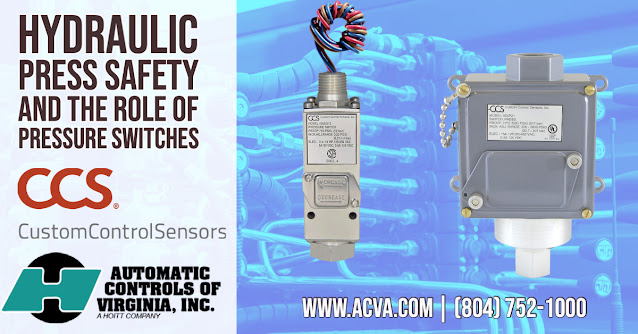
With CCS pressure switches, you can protect your hydraulic equipment, personnel and operations. 


You and your team can improve productivity, quality, and employee morale by learning more about hydraulic safety precautions. CCS strives to provide high-quality pressure or temperature switches, cutoff switches, and emergency shutdown switches for those working in industrial hydraulics. The pressure switches in the 604P and 6900P series cater specifically to hydraulic applications.


For more information on CCS pressure and temperature switches in Virginia, contact Automatic Controls of Virginia.

Automatic Controls of Virginia
https://acva.com
(804) 752-1000 

Flowrox Pinch Valves - The Ideal Valve for Abrasives, Slurries, Powders or Granular Substances

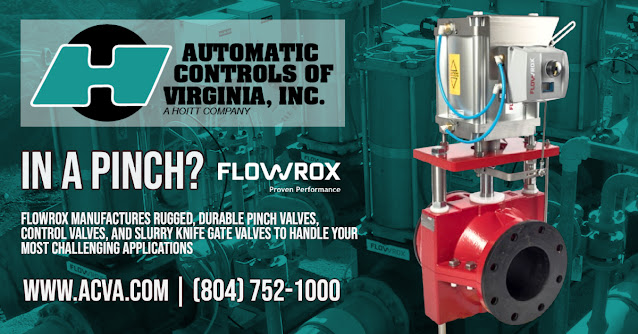
Heavy duty pinch valves from Flowrox are intended for shut off and control applications involving abrasive or corrosive slurries, powders, or granular substances. The valve is full bore and has no flow restrictions when it is in the open position. Two pinch bars squeeze the valve sleeve shut on the centerline during closing. Even if solids have accumulated on the sleeve wall, a bubble tight shut-off is provided. 

For more information, contact Automatic Controls of Virginia. Call (804) 752-1000 or visit https://acva.com.

"In A Pinch" for a Valve That Will Last in Your Toughest Slurry and Abrasive Applications? Flowrox Valve Solutions In Virginia and Washington D.C.

Flowrox Valve Solutions In Virginia and Washington D.C.

Heavy-duty pinch valves from Flowrox are built to last and are ideal for shut-off and control applications involving abrasive or corrosive slurries, powders, or coarse materials. The operation of Flowrox pinch valves is straightforward. The valve is full bore and has no flow restrictions when it is in the open position. Two pinch bars squeeze the valve sleeve shut on the centerline during closing. The sleeve is naturally wear-resistant, and when particles strike the rubber surface of the sleeve, the energy is absorbed and released when the rubber bounces back. Even if solids have accumulated on the sleeve wall, heavy-duty pinch valves provide bubble-tight shut-off. Any crystallized particles flake off the sleeve surface when compressed. The full bore structure ensures that the medium flows freely. 

Flowrox control valves handle the most demanding control applications where conventional valves wear out due to increased turbulence.  When the controlled flow is abrasive, having only one wear-resistant valve part in contact with the medium is significant. Maintenance and spare parts are no longer required. Each valve can be sized and optimized for the best control range, limiting wear and velocity while preventing cavitation in the control valve. Controllability is improved further by using conical sleeves and smart positioners. The Flowrox Control Valve Sizing Program is available to help you with your work. Sizing adheres to the international IEC60534 standard (which is compatible with ANSI/ISA S75). 

Even in the most demanding process conditions, Flowrox slurry knife gate valves isolate flow. The entire valve design maintains the concept of ease of maintenance in mind. Flowrox Slurry Knife Gate Valves evolved from the company's years of experience in providing dependable solutions for abrasive and corrosive process applications.  A load distribution ring prevents over-compression and ensures tight sealing between the sleeve and the valve gate. The load distribution ring is integrated into the valve sleeves to simplify maintenance. The universal tower design of the valve accommodates most actuator types, allowing for actuator interchangeability. In addition, the tower ensures that the top plate, body, and actuator are always aligned and that the gate is in the proper position. The valve body is a one-piece casting, so there is no need for sealing between the body halves.

Automatic Controls of Virginia | (804) 752-1000 | https://acva.com

The Bettis XTE3000 Electric Actuator

The Bettis XTE3000 intelligent multi-turn electric actuator is part of the Bettis family of actuators. The XTE3000 meets the most demanding valve automation demands of the Oil & Gas, Power, and Process industries. It is compliant with many international standards, making it the ideal solution to your plant's safety and reliability requirements. 

For more information about sales, service, and support of Bettis or EIM products, contact Automatic Controls of Virginia. Call (804) 752-1000 or visit https://acva.com.