Showing posts with label CCS DualSnap. Show all posts

Why Mechanical Switches Remain Essential in Today's Industrial Instrumentation

Why Mechanical Switches Remain Essential in Today's Industrial Instrumentation

Mechanical industrial pressure and temperature switches, the reliable backbone of safety systems, process controls, and equipment protection, are indispensable in today's industrial instrumentation schemes. Their reliability, simplicity, and ability to function under harsh conditions where electronic sensors might fail, instill a sense of security and confidence in their use.

Maintaining precise control over pressure and temperature is essential for efficient and safe operations in industrial environments. Mechanical switches provide direct and immediate responses to changes in these parameters. Unlike electronic sensors that require power sources and can be susceptible to electromagnetic interference, mechanical switches operate purely on mechanical movement. This independence from external power enhances their reliability, especially in critical applications where power loss could lead to catastrophic consequences.

The robustness of mechanical pressure and temperature switches makes them ideal for use in extreme conditions. They can withstand high temperatures, vibrations, and corrosive environments without compromising functionality. For instance, these switches are often used in drilling operations where heat or pressure surges in the oil and gas industry might damage electronic devices. Their ability to perform consistently in such demanding situations ensures continuous monitoring and control, preventing accidents and equipment failures.

The simplicity and ease of maintenance of mechanical switches, their straightforward design that allows for quick troubleshooting and repairs, instills a sense of practicality and cost-effectiveness. Technicians can easily adjust setpoints and calibrate the switches without the need for specialized tools or software, reducing maintenance costs and enhancing overall operational efficiency.

Mechanical switches also provide fail-safe operation, a critical feature in safety systems. In the event of system failure or loss of power, these switches can default to a safe state, triggering alarms or shutting down equipment to prevent damage or injury. This inherent safety mechanism is vital in industries such as chemical manufacturing, where uncontrolled reactions due to pressure or temperature deviations can have severe consequences.

The continued relevance of mechanical pressure and temperature switches is also evident in their compatibility with various industrial standards and certifications. They meet stringent safety and performance requirements, making them suitable for regulated industries. Their proven track record over decades of use instills confidence in engineers and plant operators who rely on these devices for critical applications.

In an era where digitalization and automation are transforming industries, mechanical switches still hold significant importance. They often serve as primary control devices or backups to electronic systems, providing an extra layer of safety and reliability. Their ability to operate independently of complex software or power supplies makes them indispensable in scenarios where electronic systems might be vulnerable.

Mechanical industrial pressure and temperature switches remain integral components of modern industrial instrumentation schemes. Their reliability, robustness, and simplicity make them essential for maintaining safety, efficiency, and continuity in industrial operations. As industries continue to evolve, these mechanical devices will continue to provide the dependable performance that has made them a cornerstone in industrial processes worldwide.

Custom Control Sensors (CCS) mechanical switches offer an exceptional choice for chemical, power, oil and gas, and water treatment applications. CCS has built a reputation for delivering high-quality mechanical pressure and temperature switches that meet the rigorous demands of these sectors. Their switches provide unmatched reliability and durability, essential for environments where equipment must perform flawlessly under extreme conditions.

Moreover, CCS emphasizes compliance with industry standards and certifications, offering assurance that its switches meet the stringent requirements of regulated industries. Its commitment to quality and innovation makes it a trusted partner for companies seeking dependable mechanical switches for critical applications. By choosing CCS mechanical switches, businesses in the power and water treatment sectors can breathe a sigh of relief, knowing they are investing in devices that are not only reliable but also easy to install and maintain, reducing downtime and operational costs.

Automatic Controls of Virginia
https://acva.com
(804) 752-1000

Mechanical Pressure and Temperature Switches: The Vital Role They Play in the Chemical Processing Industry

Mechanical Pressure and Temperature Switches: The Vital Role They Play in the Chemical Processing Industry

The chemical processing industry is a critical sector that transforms raw materials into valuable and functional products. All processing plant components must function optimally to ensure efficiency and safety. A crucial element in these facilities is mechanical pressure and temperature switches, which play a vital role in controlling and monitoring various processes. 

Safety and process control

The chemical processing industry often involves hazardous materials, extreme pressures, and temperatures. Mechanical pressure and temperature switches are vital in ensuring the safety of the equipment and personnel in these facilities. They function as safety devices, monitoring, and controlling processes to prevent accidents and damage to equipment. They can detect deviations from the desired process conditions and trigger necessary actions to maintain the desired pressure and temperature levels.

Improved efficiency and productivity

Mechanical pressure and temperature switches contribute to overall efficiency in chemical processing plants. These switches optimize the use of energy, resources, and time by providing precise control over process conditions. This results in reduced waste, energy consumption, and increased productivity, which is essential for a competitive and sustainable industry.

Regulatory compliance

The chemical processing industry is subject to strict regulations concerning safety, environmental impact, and product quality. Mechanical pressure and temperature switches help plants comply with these regulations by ensuring processes operate within the required parameters. Proper process control also reduces the risk of accidents and emissions, preventing potential fines and legal actions.
Applications of Mechanical Pressure and Temperature Switches in the Chemical Processing Industry

Reactor control

Chemical reactions often require specific pressure and temperature conditions to proceed optimally. To monitor and maintain these conditions, mechanical pressure and temperature switches are employed in reactor vessels, ensuring that the reactions occur efficiently and safely.

Distillation columns

Distillation is a widely used separation technique in the chemical industry. Pressure and temperature switches are essential in distillation column control, ensuring the proper operating conditions are maintained, allowing for the efficient separation of components, and preventing the possibility of column flooding or equipment damage.

Heat exchangers

Heat exchangers are commonly used in chemical processing to transfer heat between fluids. Mechanical pressure and temperature switches are vital in maintaining the desired conditions within heat exchangers, preventing overheating and ensuring the heat transfer process occurs efficiently.

Pump and compressor control

Pumps and compressors are crucial components in the chemical processing industry that transport fluids and gases throughout a plant. Pressure and temperature switches help control these devices' operation, ensuring that they function optimally and safely.

Mechanical pressure and temperature switches play a crucial role in the chemical processing industry, ensuring various processes' safe and efficient operation. They contribute to improved productivity, regulatory compliance, and the industry's overall competitiveness. As technology advances, these switches will become even more sophisticated and reliable, enhancing their importance and application in the chemical processing sector.

For more information about CCS pressure and temperature switches in Virginia, contact Automatic Controls of Virginia. Call them at 804-752-1000 or visit their web site at https://acva.com.

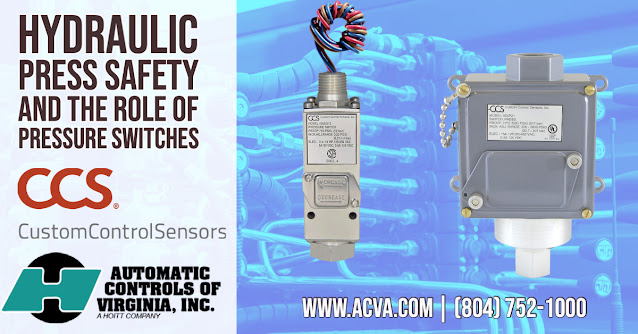
Hydraulic Press Safety and the Role of Pressure Switches

Hydraulic Press Safety and  the Role of Pressure Switches

Hydraulic systems have various functions and applications, from industrial manufacturing to robotics and steel processing. They are analogous to pneumatics, which easily compressible gas to perform tasks. Hydraulic systems, on the other hand, use incompressible liquids as their fluid rather than compressible gases. Repetition–hydraulic systems are industry preferred low-cost, efficient ways to generate movement. 

To use these systems effectively, workers must understand the risks and potential hazards associated with hydraulics. Your employees could be in danger if they are unaware of the extreme fluid pressure, maintenance, and heavy workload. Fortunately, various safety precautions reduce the risk of injury or death significantly. 

Our hydraulics safety precautions guide will cover common hazards and precautions to keep you and your employees safe.

How Does A Hydraulic Press Work? 

Hydraulic press systems use a pump that pushes fluid throughout the machine to create energy in its simplest form. The fluid then enters a set of valves and flows to the cylinder, where hydraulic power changes back to mechanical energy. When necessary, these valves also help control the liquid’s movement and relieve pressure.

There are several types of hydraulic press systems on the market. Depending on your application or industrial setting, you will most likely use one of the following: 

  • An Arbor press uses a narrow range to support the disposal, seating stamping, manufacturing, and repairing of equipment.
  • An H Frame press (or four-column) is the standard in many businesses for its versatility. They are used to straighten, bend, shape, stamp, or cut metal objects.
  • C Frame press systems are relatively smaller than H frames but maintain similar utility and flexibility in a light yet compact build.
  • Custom presses provide solutions for a company’s personal needs and specifications.
  • Press brakes clamp and bend sheet metal and plate material.
Although these machines make work easy and productive, they are still highly dangerous and can break down if not properly maintained.

The Most Common Reasons for Hydraulic System Failure 


Hydraulic systems can fail, whether with a custom press or a four-column frame. After a while, presses may begin to show wear and tear in critical areas. Many damages, however, can be avoided with regular maintenance checks and care. 


Let's look at five common causes of hydraulic system failure and electric and hydraulic tool safety practices. 


1. Poor Maintenance 


Maintenance is essential for keeping your hydraulic press operating at peak efficiency. Here are some components and functions to consider during the evaluation:

  • Hoses 
  • Oil leaks
  • Ram Speed
  • Wire tightness
  • Oil temperature
  • Electrical Fuses
  • Solenoids and relays
  • Oil level and particle count
  • Hydraulic fittings for tightness
  • Coupling and insert for tightness
  • Pressure adjustment for the full range

If these functions are not maintained, presses will fail at a high cost. Daily inspection and standard maintenance will extend its service life and, most importantly, keep workers safe. 


2. Leaks through pinholes 


Pinhole leaks can cause toxic fluid leakage at speeds of up to 600 feet per second. Although they may be difficult to spot at first, pressure switch technology will alert the user of a leak before any visible signs appear. To ensure proper utility, it is still necessary to inspect your hoses during the inspection process. 


3. Inadequate Couplings 


Improper coupling of low- and high-pressure systems is another dangerous hazard. It is never a good idea for you or your employees to connect a high-pressure pump to a low-pressure system because component, hose, or fitting ruptures can occur. 


4. Removal or modification of a component 


Servicing a hydraulic system while the machine engine is running is very likely to result in bodily harm or death. Remove no components while the working units are resting on the ground, safety stands, or blocks; always turn off the engine when doing so. 


5. A Low and High-Pressure Warning 


Workers may be exposed to three types of hazards when removing or adjusting components without first releasing the pressure:

  • Burns from hot, high-pressure fluid
  • Bruises, cuts, or abrasions from flailing hydraulic lines
  • Hydraulic injection of fluid into the skin 


To avoid these common mistakes, educate yourself on hydraulic press systems and carefully follow instructions. 


With CCS pressure switches, you can protect your hydraulic equipment, personnel and operations. 


You and your team can improve productivity, quality, and employee morale by learning more about hydraulic safety precautions. CCS strives to provide high-quality pressure or temperature switches, cutoff switches, and emergency shutdown switches for those working in industrial hydraulics. The pressure switches in the 604P and 6900P series cater specifically to hydraulic applications.


For more information on CCS pressure and temperature switches in Virginia, contact Automatic Controls of Virginia.

Automatic Controls of Virginia
https://acva.com
(804) 752-1000 

Pressure and Temperature Switches for Water and Wastewater Treatment

Switches for Water and Wastewater Treatment

Water treatment occurs before the water reaches a business or community, whereas wastewater treatment occurs after the business or community uses the water. 

Water treatment has higher pollution control standards and necessitates more costly treatment procedures such as chemical coagulation and flocculation and the use of granular activated carbon filters. However, contaminant levels are usually low and predictable because most water goes through water treatment from a natural source (such as a river). 

After a business or community uses water, it becomes wastewater and is in most cases returned to the environment after treatment. The treatment standards are typically lower than those used in drinking water facilities. Unlike water treatment, wastewater treatment does not usually take place in a single location. Certain enterprises with highly dirty wastewater must have their treatment system before delivering it to community wastewater treatment plants. 

Temperature and pressure switches apply to many water and wastewater treatment processes at practically every stage. Water flow sensors and switches enable pump vibration control, handle slurry environments, monitor pressure spikes, and endure corrosive media, and address the application difficulties of water and wastewater treatment systems. CCS pressure switches are resilient to pump impulses, pressure spikes, and hammering thanks to Belleville disc spring technology, tight construction, and durable assembly.

For more information about CCS pressure and temperature switches in Virginia, contact Automatic Controls of Virginia. Call them at 804-752-1000 or visit their web site at https://acva.com.

Trace Mechanism or Snap-Action - What's in Your Pressure Switch?

Complex systems and processes can use either a trace or a snap-action switch to provide an electrical response to the rise or fall in pressure or temperature. System pressures and temperatures rarely follow a smooth pattern of rising and falling. The switches used to track and control the system are subject to those fluctuations, as illustrated in the following graph.

Deciding whether to use a snap-action design is critical to your switch's efficiency, accuracy, and longevity. This video will cover key differences between each device and how they apply to the switch operation. 

What is the difference between a trace switch and a snap-action switch? 

In their simplest form, pressure switches have two components: a mechanism that reacts to a change in pressure and an electrical switch (sometimes called a micro-switch). When the pressure or temperature reaches a certain level (the set-point), the mechanism moves to actuate the switch. This process can either allow or stop currents in the control circuit.

What is a Trace Mechanism?

Common alternative mechanisms to snap-action devices are trace designs, also known as spring-based mechanisms. Switches with a trace mechanism follow or trace the exact pattern of pressure or temperature changes. These trace devices can include a helical spring or spiral spring, a Bourdon tube, or bellows in their mechanism. 

A spring-based trace switch mimics the pattern of changes even after reaching set-point. The mechanism and micro-switch are in constant motion when there are changes in pressure in the system. This continual movement wears on the components of the instrument and electrical switch. And over time, it causes the set-point to drift from the original setting to fatigue and the mechanism's failure. 

What is a Snap-action Mechanism?

Unlike trace switches, a snap-action mechanism remains inactive during system pressure and temperature changes. Upon reaching the set-point, the snap-acting disc immediately reacts to activate the switch. Eliminating this continuous motion until the point of activation and deactivation can reduce the mechanism and switch element wear, extending its duration. 

Snap-action designs are the premium type of switch on the market. They can perform 10 million cycles or more due to the components' low fatigue, including the micro-switch. 

While trace and snap-action pressure and temperature switches may perform the same function, understanding the difference in their movement and precision explains why quality-minded people prefer snap-action controls over other designs. Trace designs fatigue the mechanism and the internal micro-switch through constant motion. Snap-action switches use an innovative snap-action disc spring that remains still despite fluctuations until action is needed. 

CCS pioneered the Dual-Snap, snap-action disc used to provide accurate and reliable pressure and temperature measurement under every operation. For more information on CCS pressure and temperature switches in Virginia, contact Automatic Controls of Virginia.

Automatic Controls of Virginia
https://acva.com
(804) 752-1000 

Extremely Rugged, Hazardous Area Pressure Switch - The 6900GE from Custom Control Sensors (CCS DualSnap)


The Custom Control Sensors hazardous location 6900GE Series is the most popular, all-around, all-aluminum gage pressure switch. The series is UL/CSA explosion proof, Class I, Groups A, B, C and D, and Class II Groups E, F and G certified. NEMA 4X and IP66 rating is optimum for wet conditions.

It is designed with high vibration and shock resistance utilizing Dual Snap® disc spring technology ensuring high accuracy and repeatability. It comes with high over-pressure capabilities and still relatively compact in size to conveniently mount on panels. It meets the demand for all applications commercial, industrial and otherwise. 

6900GE Industrial Applications Include:

  • Oil & Gas
  • Power Generation
  • Fluid Management
  • Chemical Refining and Processing
  • Manufacturing Process
  • Utilities, Water Treatment and Waste
  • Safety Systems

For more information about CCS DualSnap products, contact Automatic Controls of Virginia. Call them at 804-752-1000 or visit their website at https://acva.com.

Automatic Controls of Virginia is Now the Authorized CCS DualSnap Distributor in Virginia and Washington D.C.


Automatic Controls of Virginia is very pleased to be appointed the Authorized Distributor for Custom Control Sensors, also known as CCS DualSnap, in the Commonwealth of Virginia as well as in Washington, D.C.

CCS DualSnap is a leader in providing pressure and temperature sensing products for the Aerospace, Defense, Industrial and Energy industries. CCS’ designs utilize the proven, rugged “Dual-Snap®” disc spring and advanced sensing technologies to provide their customers superior solutions for pressure and temperature applications.

For more information, contact Automatic Controls of Virginia. Call them at (804) 752-1000 or visit their website at https://acva.com.